Christmas Kitchen Cabinet Decor on a Budget
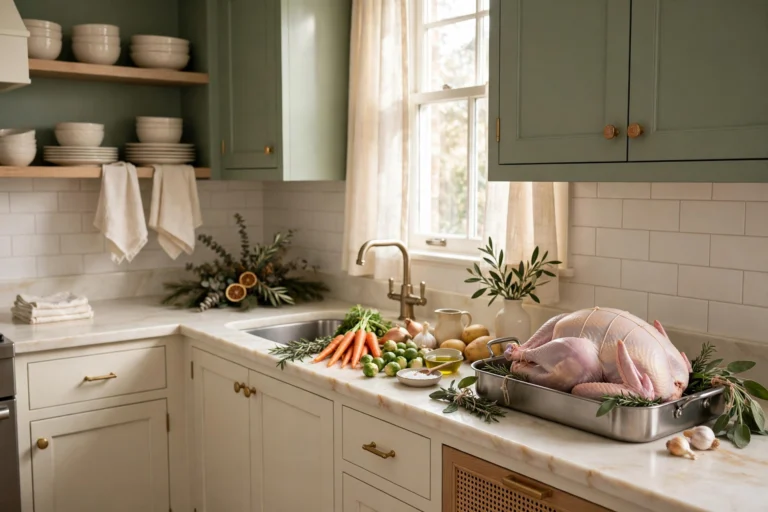
The kitchen is where Christmas actually happens. It is where the cookies are baked, the hot chocolate is made, the guests gather while dinner cooks, and the family ends up standing even when the living room is free. So it makes sense that the kitchen deserves a little Christmas of its own. The good news is that kitchen cabinets are the easiest place in the house to decorate, because they are tall, flat, and mostly empty on top. A garland on top of the cabinets, a wreath on one door, and a few festive jars on the counter will make the whole kitchen feel like December, for a few dollars, without moving a single appliance.
This article is written for a small kitchen, not a big one. A kitchen with a few cabinets, one stretch of counter, a small island or a table, and not much spare space. Everything here is renter-friendly, costs a few dollars, and can be packed away in one small box in January. Nothing is drilled, nailed or glued. The kitchen stays usable the whole month, because the decorations live on top of the cabinets and on the doors, not on the counters where you cook.
The budget for the whole look is twenty dollars, and most readers will spend less, because the biggest changes cost nothing. Clearing the counters, grouping the jars, and moving one plant are free. The money goes to a garland, a small wreath, a string of battery lights, and a festive towel or two. That is the whole list. The kitchen does the rest, because a tidy kitchen with a garland on top of the cabinets already looks like Christmas.
Clear the counters first, then decorate
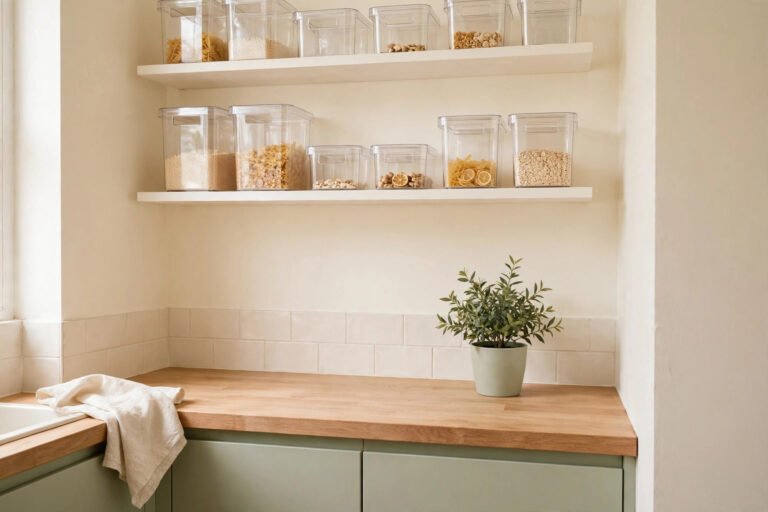
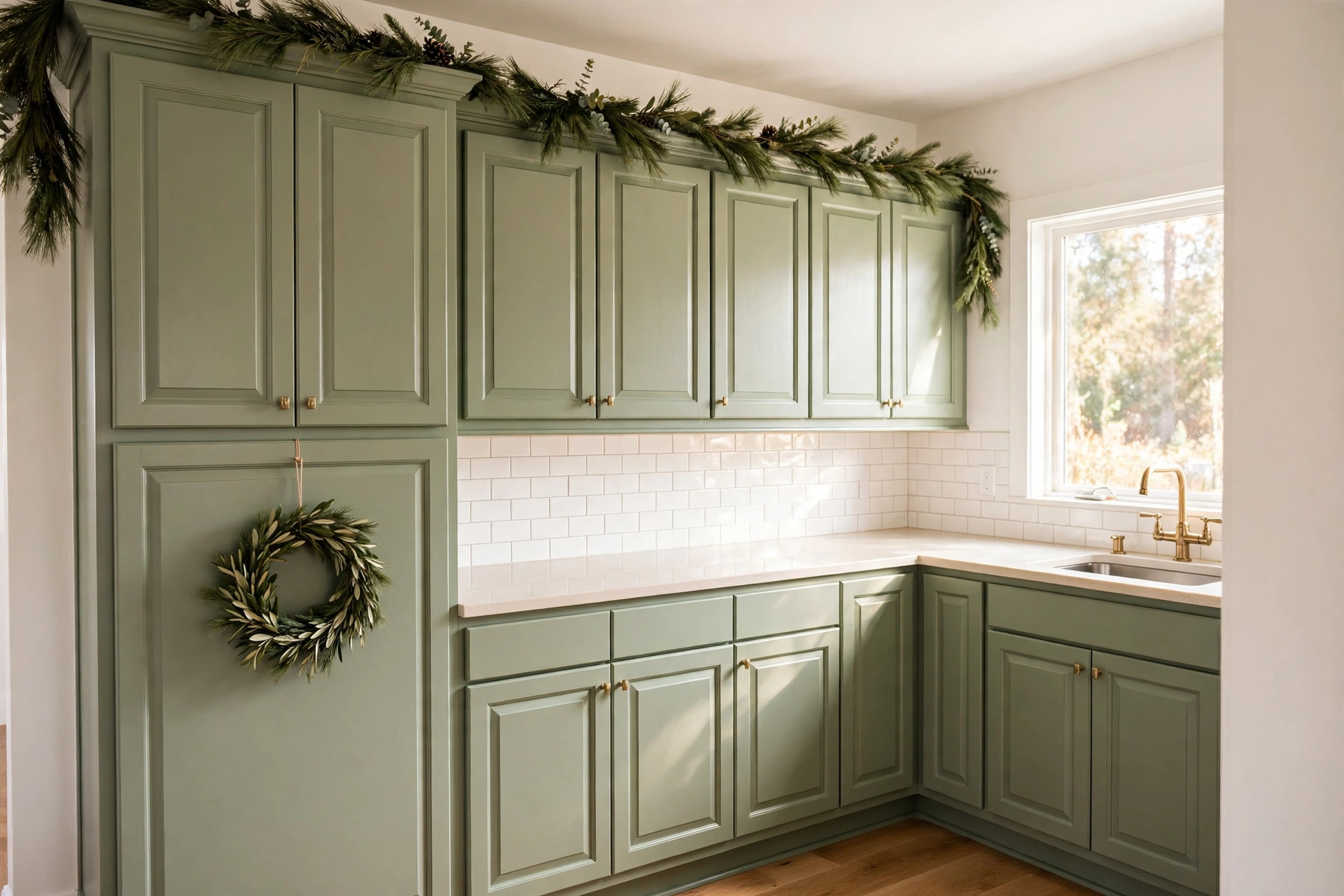
Every good Christmas kitchen starts the same way, and it is not shopping. It starts with clearing the counters. Take everything off the counters and wipe them down. Then put back only what you use every day: the kettle or coffee maker, one cutting board, the soap, and one or two things you reach for constantly. Everything else goes into a cabinet, a drawer, or a basket on top of the fridge. This one step takes fifteen minutes and it does more for the kitchen than any decoration, because a clear counter makes the room look bigger, cleaner, and ready for a small festive touch.
Once the counters are clear, look at what is left. Most small kitchens have a bottle or two that lives on the counter because there is nowhere else for it. That is fine. Group those bottles together on a small tray or a folded tea towel so they look intentional instead of scattered. A tray, even a cheap one from the dollar store, turns a cluster of bottles into a display. If you do not have a tray, a small plate or a wooden board does the same job.
Now check the top of the cabinets. In most kitchens the top of the cabinets is a forgotten shelf where old boxes, spare vases and things with no home end up. Clear it completely. Wipe it down. This is where the garland will go, and it needs a clean, empty surface. If the top of the cabinets is dusty, the garland will look dusty too. A clean surface takes five minutes and it makes the whole decoration look fresh.
Garland on top of the cabinets
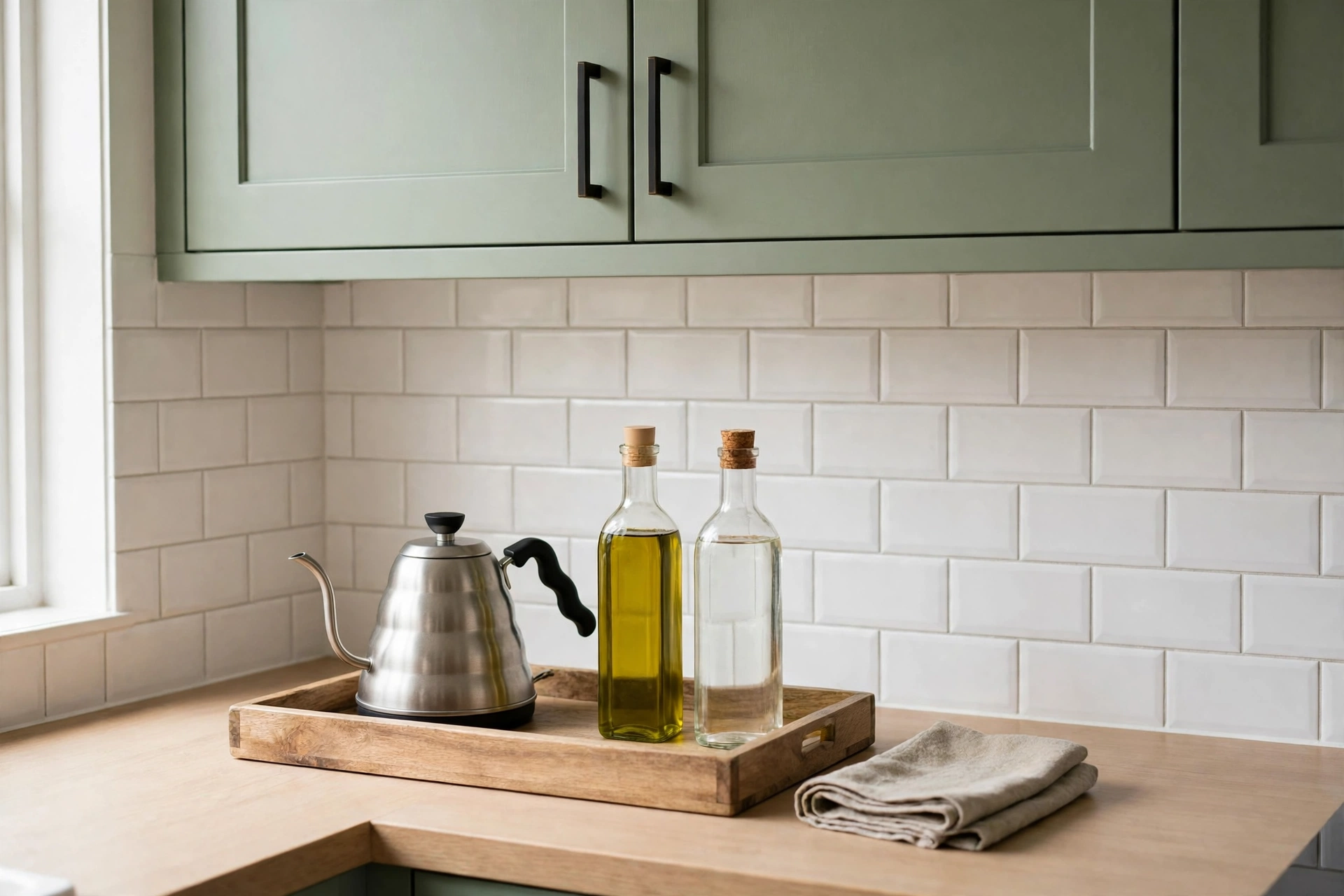
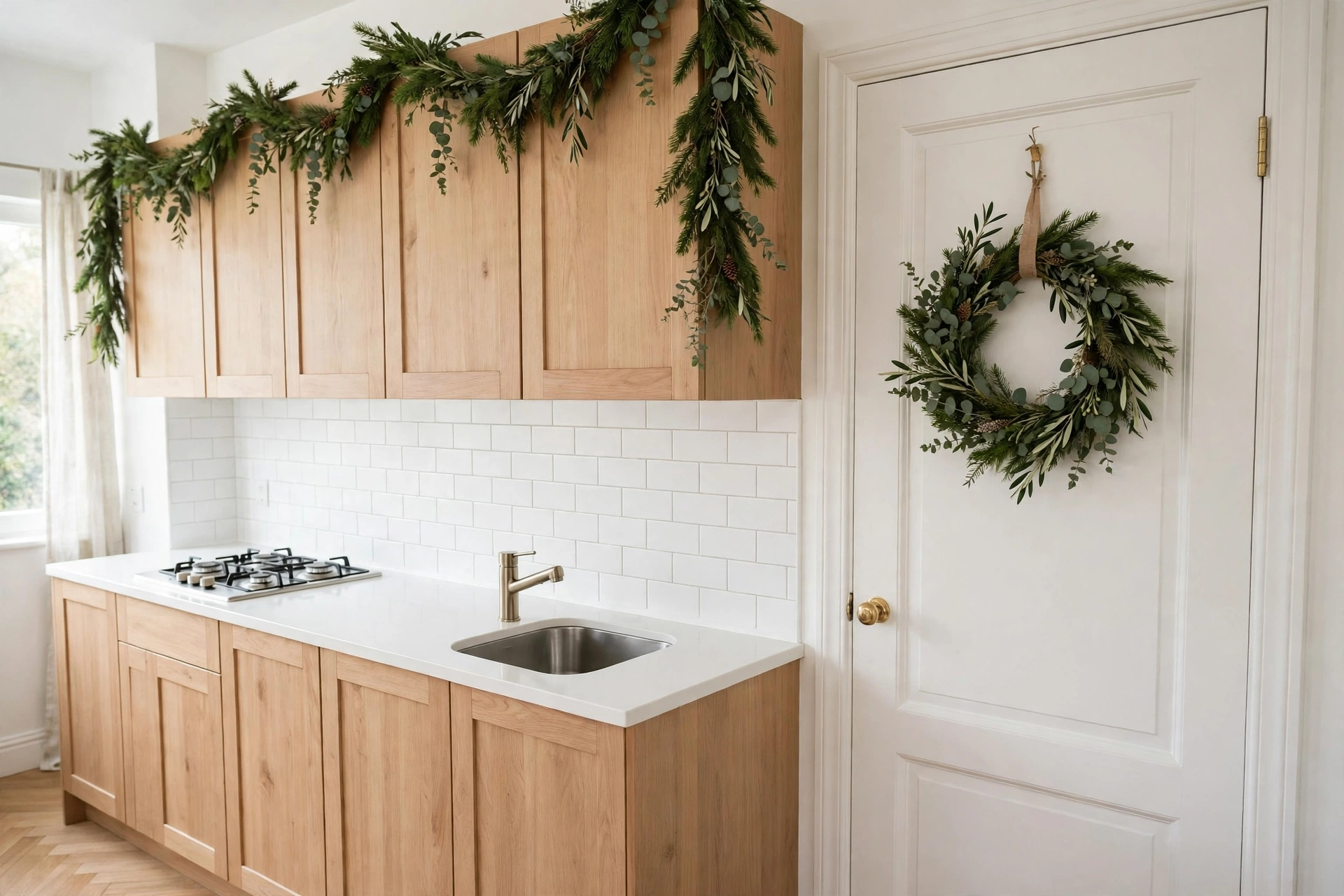
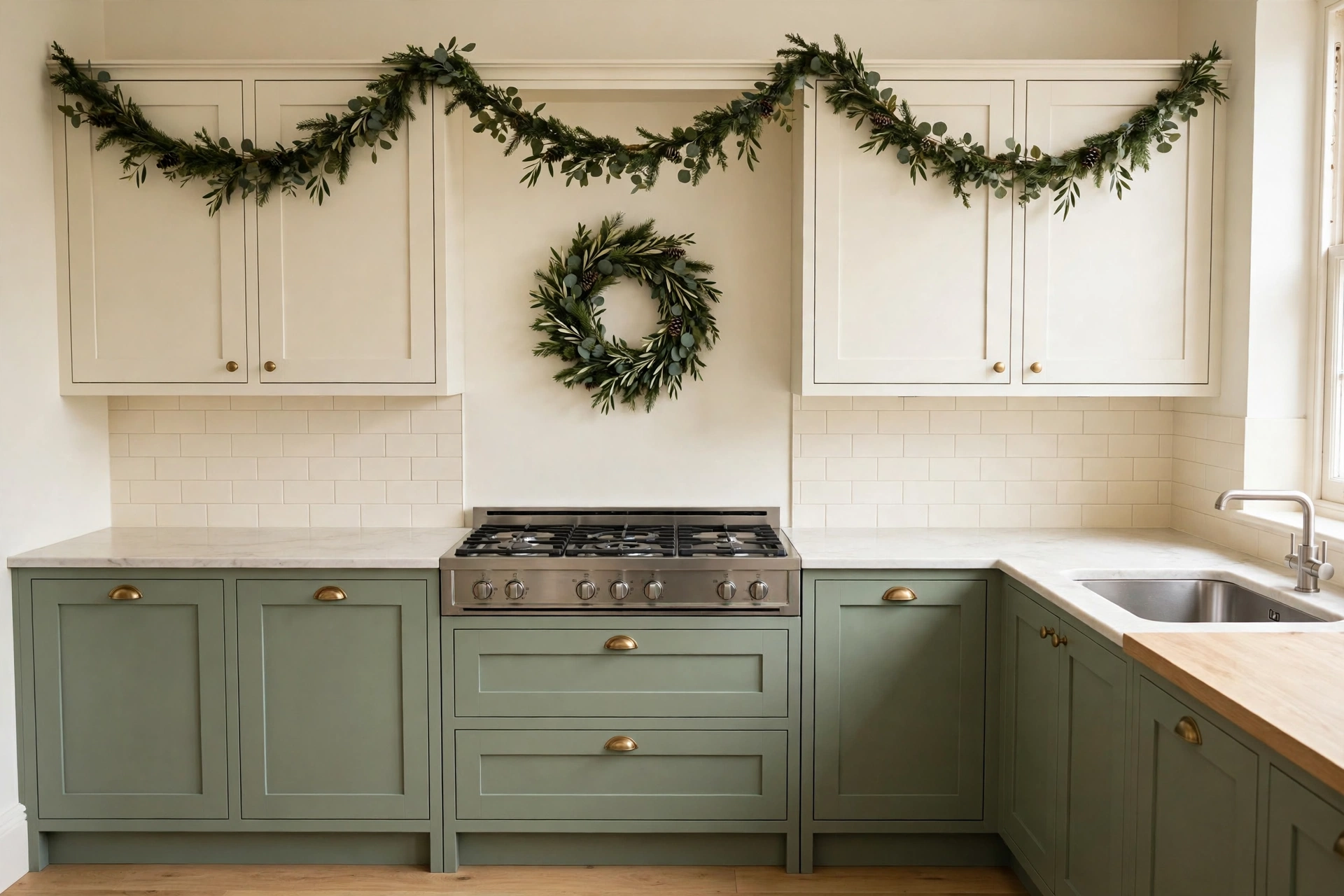
Garland on top of the cabinets is the single most effective Christmas decoration in a small kitchen. It costs three to five dollars, it takes five minutes to put up, and it changes the whole room, because the top of the cabinets is the highest line in the kitchen and the eye follows it all the way around. Choose a garland that is full enough to look green from the floor, but thin enough to sit neatly on top of the cabinets without falling down. A garland about three inches wide is right for most kitchens.
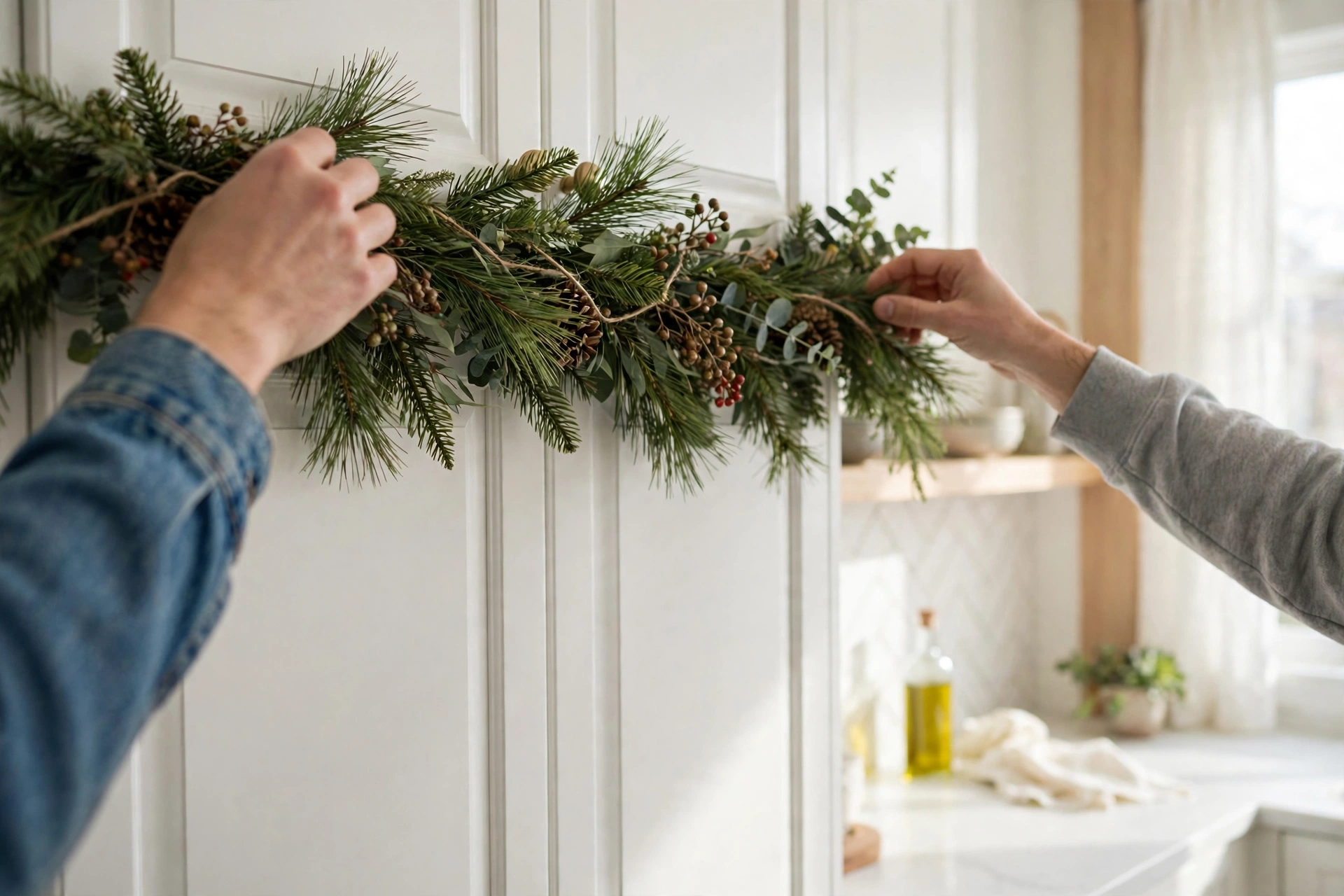
Lay the garland along the top of the cabinets and let the ends drape down a few inches at each side. The draped ends are what make it look festive instead of flat. If the garland is too long, fold the extra length back on itself instead of cutting it, so you can use the full length next year. If it is too short, leave a small gap at one end. A garland that spans most of the cabinets looks better than a garland stretched tight.
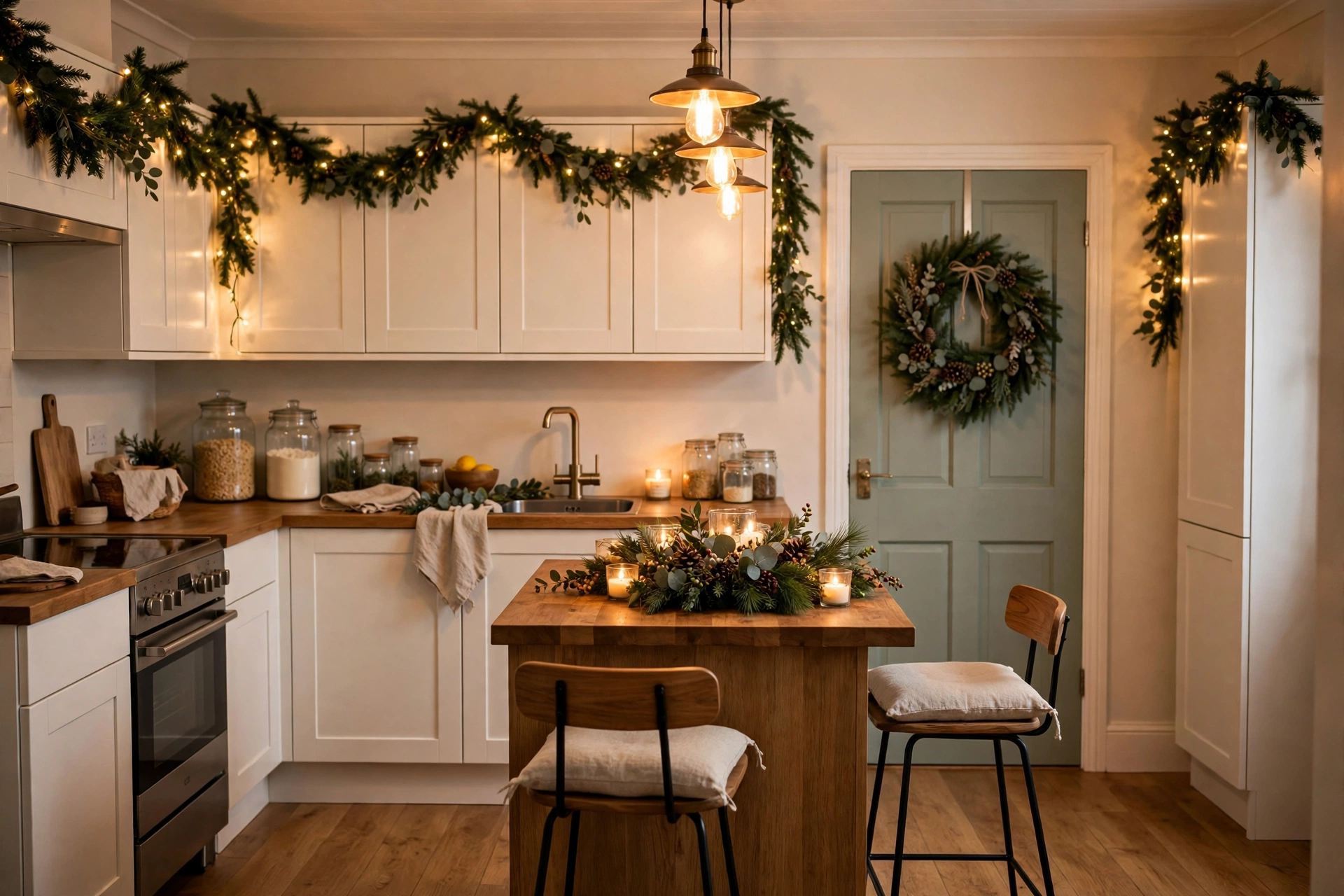
Keep the garland simple, or add one small thing. A few tiny pinecones tucked into the greenery, a short string of battery fairy lights woven through it, or a thin ribbon laid along the top. Battery fairy lights are the best choice, because there is no outlet on top of the cabinets and no cord to hide. A short string of twenty warm white lights costs two to three dollars, runs on two small batteries, and makes the top of the cabinets glow softly in the evening. Tuck the battery pack behind the garland where it is out of sight.
A wreath on a cabinet door
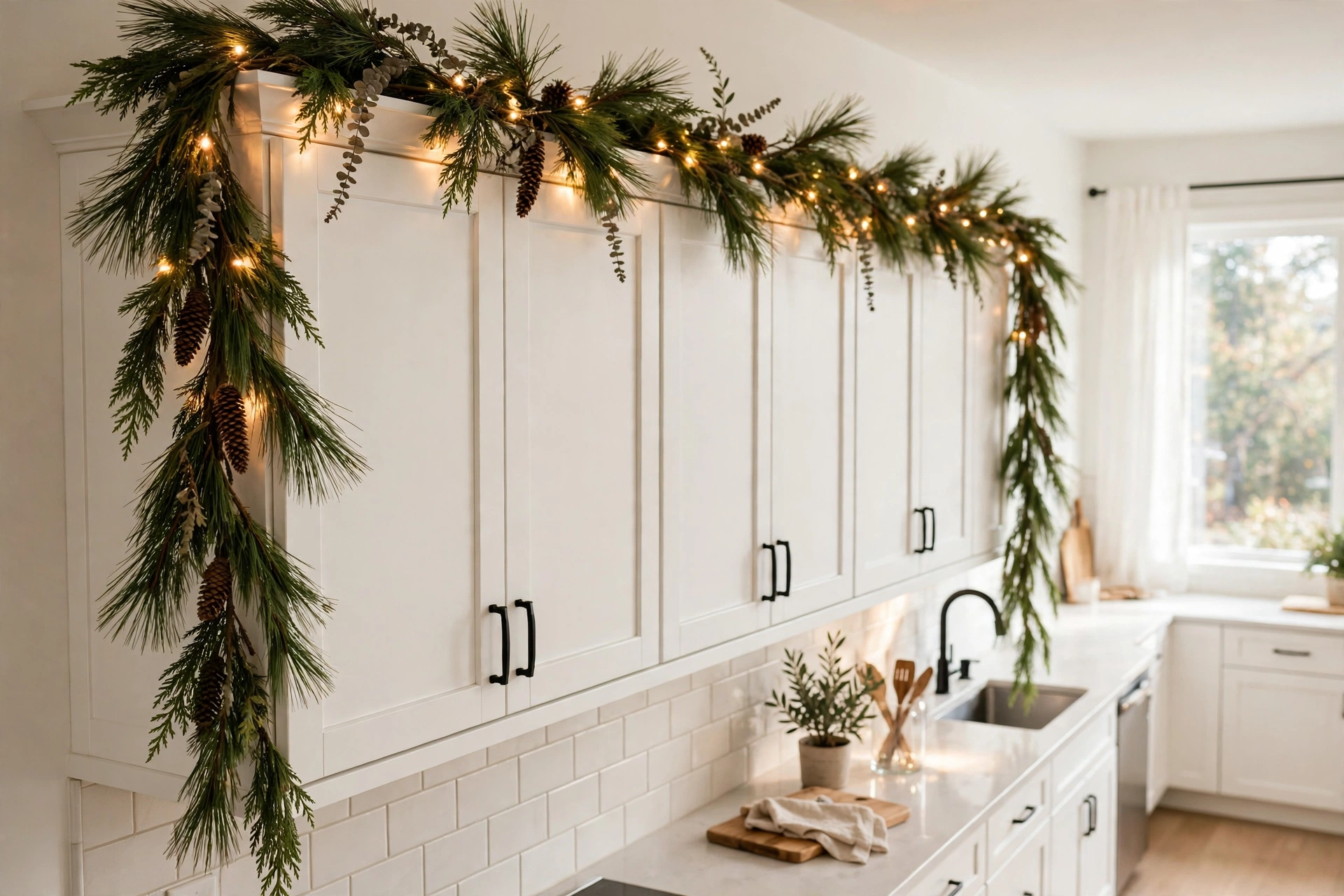
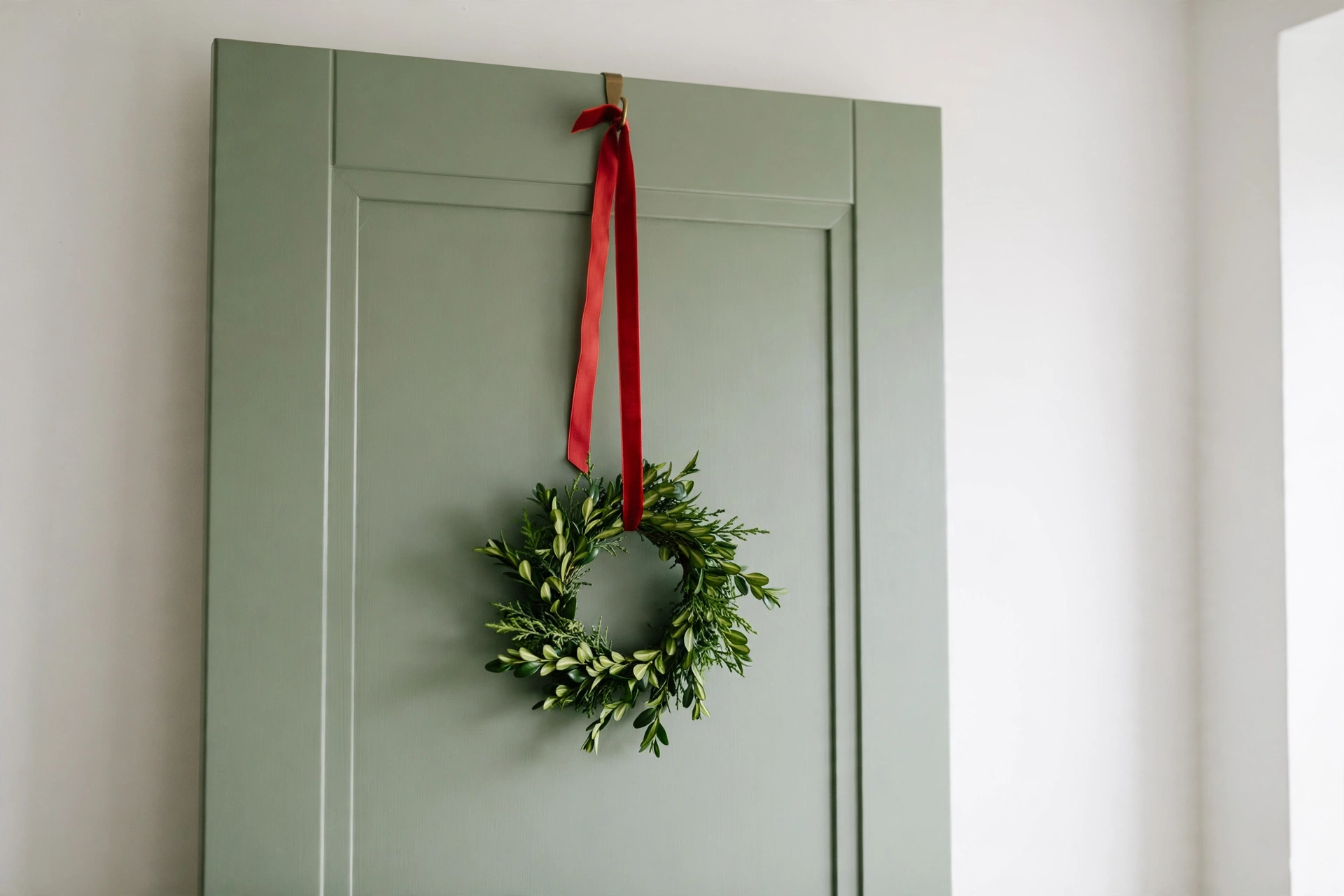
A small wreath on a cabinet door is the second decoration, and it works because it is at eye level. Choose one cabinet door, the one you see first when you walk into the kitchen, and hang a small wreath on it. The wreath should be six to eight inches across. Anything bigger will cover the whole door and get in the way when you open it. Anything smaller will disappear against the cabinet.
Hang the wreath with a small suction cup hook or a command hook on the inside of the door, with a ribbon looped over the top of the door. The ribbon-over-the-door method is the easiest, because it needs no hook at all: tie a ribbon around the wreath, loop it over the top of the door, and tape the ribbon to the inside of the door with a small piece of painter’s tape. The wreath hangs on the outside, the tape is hidden on the inside, and the door still opens and closes normally.
Keep the wreath plain. Green, a small bow, and nothing else. A wreath with too many ornaments looks busy on a cabinet door, and it fights with the garland for attention. The kitchen needs one green focal point at eye level, and the wreath is it. In January you take the wreath down, remove the ribbon, and the door is exactly as it was.
Festive jars and canisters on the counter
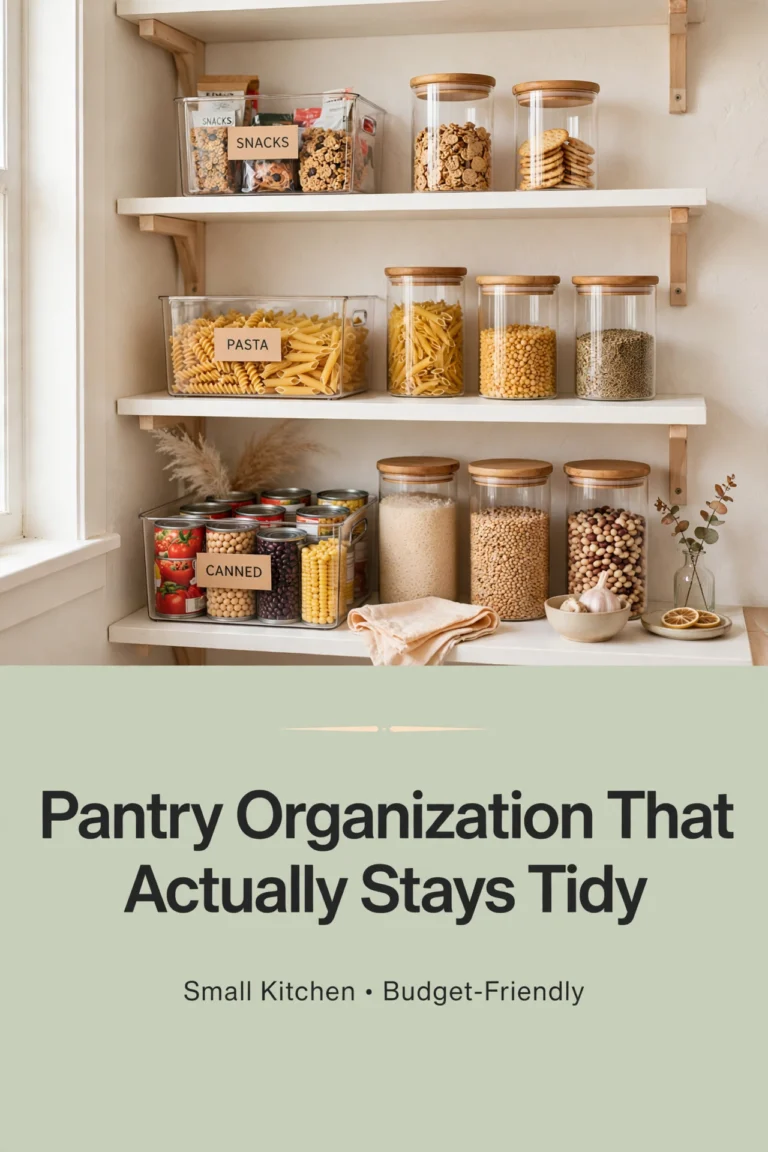
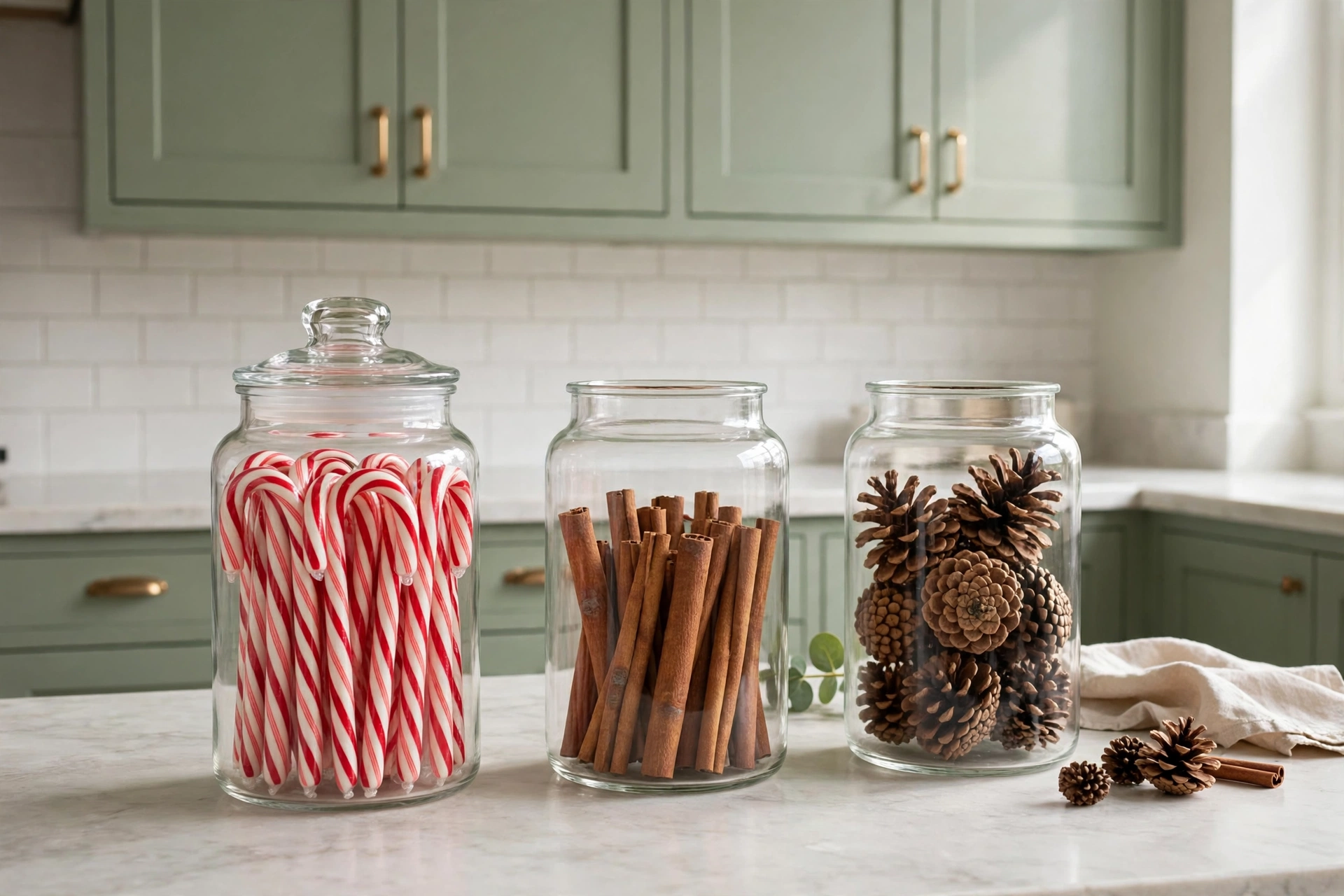
Glass jars are the hardest working decoration in a Christmas kitchen, because they are storage and decoration at the same time. Fill a clear jar with candy canes, a jar with cinnamon sticks, a jar with dried orange slices, or a jar with small pinecones. Put the jars on the counter in a small group, and the counter suddenly looks festive without losing any workspace. The jars are still storage. They hold things you use, and they look good doing it.
Use jars you already own. A mason jar, a pasta jar, a jam jar, or a storage canister all work. The jar does not need to be new. It needs to be clean and clear, so the contents show. Fill each jar with one thing, not a mix. One jar of candy canes, one jar of cinnamon sticks, one jar of pinecones. A jar with a mix of everything looks messy. A jar with one thing looks deliberate.
The island: one centerpiece, clear counters
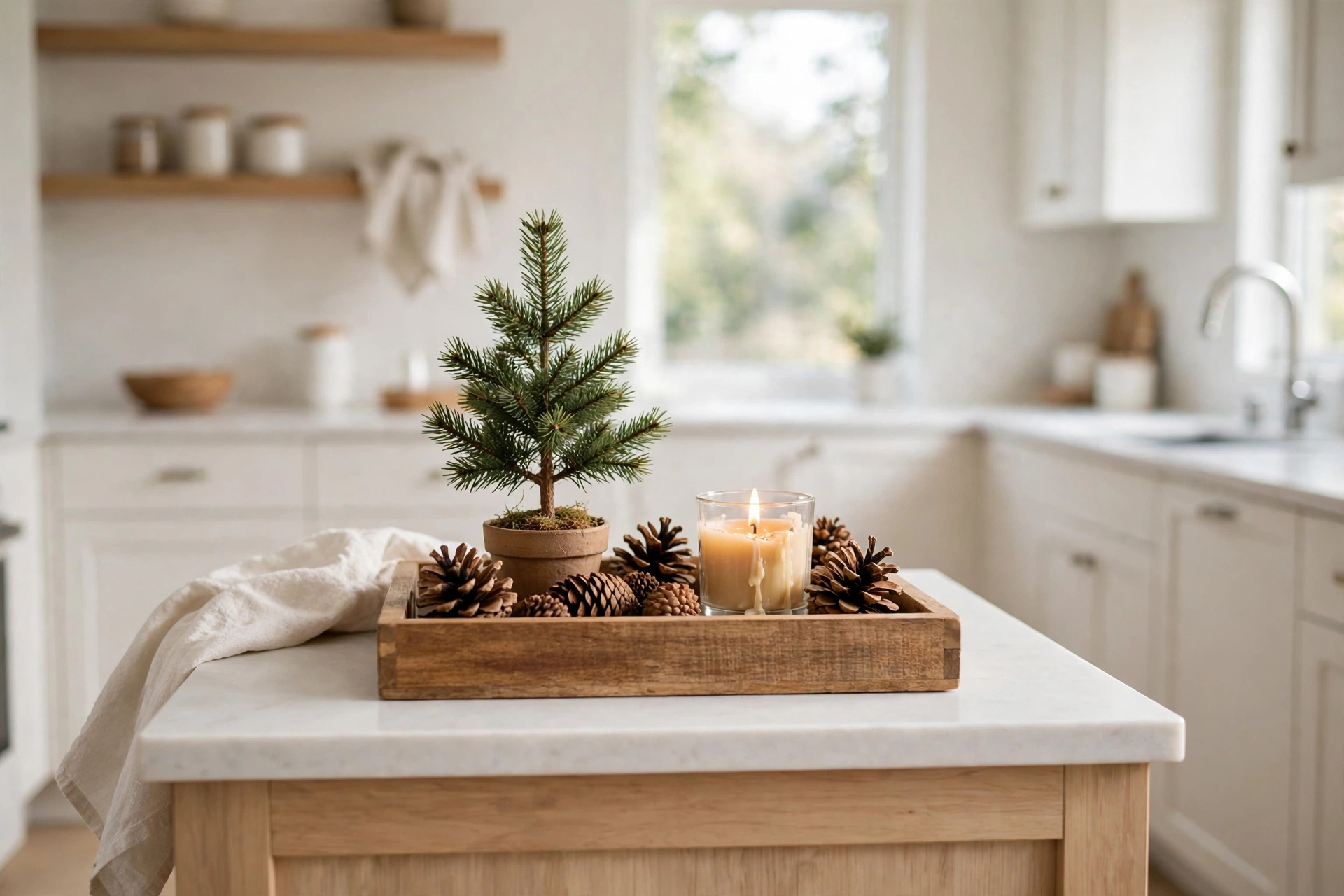
If your kitchen has an island, or a small table that acts as one, the island is the center of the room, and it needs one centerpiece and nothing else. A centerpiece is a single arrangement in the middle of the island that says Christmas without taking up the whole surface. A wooden tray with a small pine, a candle and a few pinecones. A bowl of oranges with a few sprigs of greenery. A small cake stand with a tiny wreath on it. One arrangement, in the middle, with clear space around it.
The tray matters, because it keeps the centerpiece together and it protects the surface. A wooden tray, a ceramic plate, or a flat basket all work. Put the items on the tray, and the tray on the island. When you need the island for cooking, you lift the tray and move it to one side. The whole centerpiece moves as one piece, and the island is clear in five seconds. Without a tray, the centerpiece is five separate items that have to be moved one by one, and they will end up scattered.
Keep the rest of the island clear. An island covered in mail, keys, chargers and school papers does not look festive, no matter how nice the centerpiece is. Give everything on the island a home somewhere else: mail in a basket by the door, keys on a hook, chargers in a drawer. The island is for cooking, eating and gathering. A clear island with one centerpiece is the most welcoming thing a kitchen can offer in December.
Lights without cords everywhere
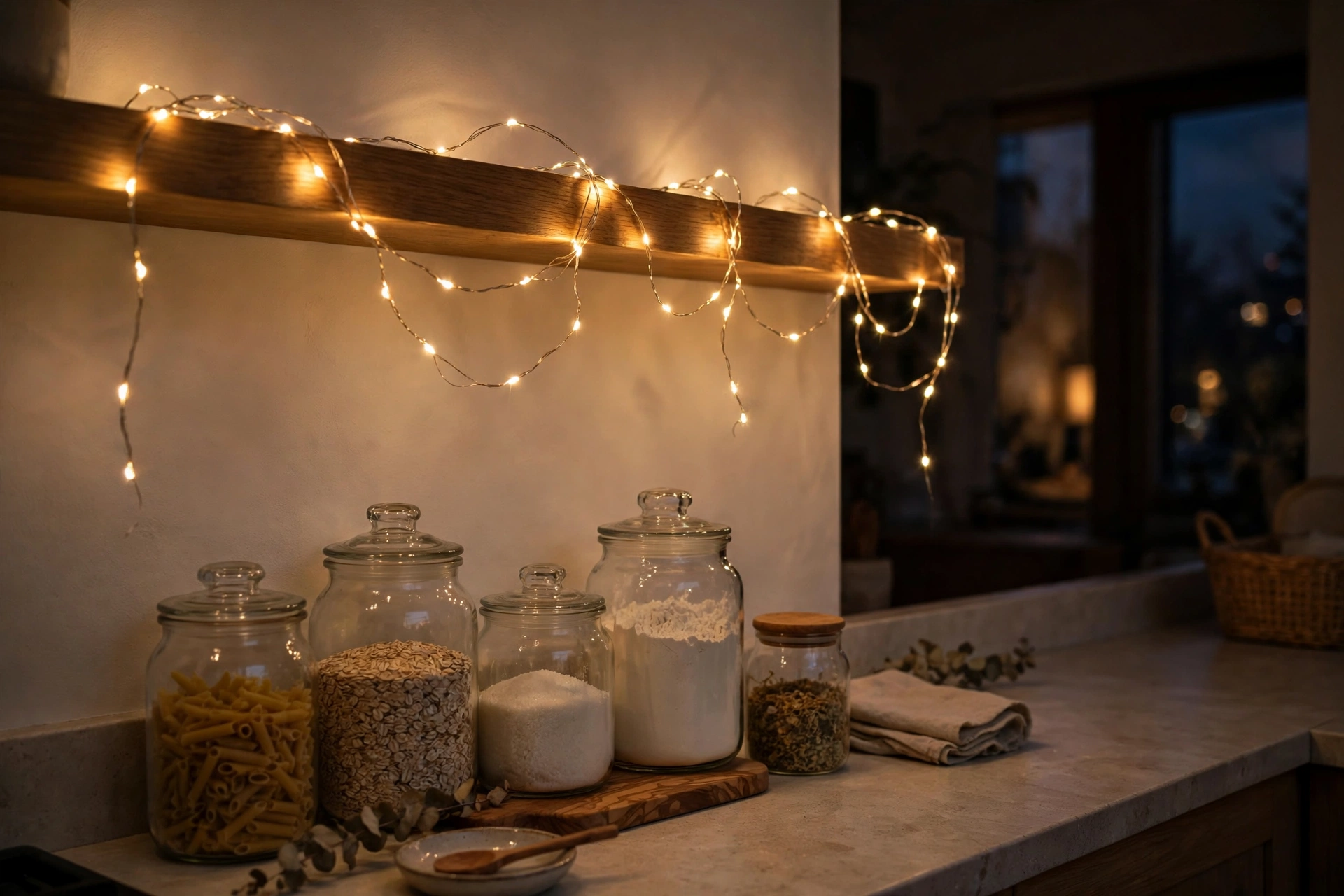
Fairy lights make a kitchen feel like Christmas in the evening, and in a small kitchen they need to be battery powered, because there are never enough outlets and a cord across the counter is a hazard. A short string of warm white battery lights costs two to three dollars and can go almost anywhere: woven through the garland on top of the cabinets, draped along a shelf, wrapped around a jar, or tucked behind the wreath. Choose warm white, not bright white and not multicolored. Warm white looks like candlelight. Bright white looks like a shop. Multicolored looks like a party.
Put the lights where they will be seen from the doorway, because that is where the kitchen is first seen. The garland on top of the cabinets is the best place, because the lights glow above the room and the whole kitchen feels warm. The shelf above the counter is the second best place, because the light falls on the jars and the backsplash. Do not put lights inside a cabinet. They will not be seen, they will get hot against the dishes, and they will be forgotten in January.
Keep the kitchen usable through the holidays
A decorated kitchen is only useful if you can still cook in it, and December is the month when the kitchen works hardest. Cookies, roasts, hot drinks, guests, and washing up, all in a small space. The decorations have to stay out of the way of the cooking, and that means three rules. Nothing on the stove. Nothing over the sink. Nothing in the middle of the main work counter.
The stove is the most dangerous place for a decoration. Greenery, ribbon and paper near a hot stove are a fire risk, and a decoration on the stove will get knocked off the moment you need the burner. Keep the stove clear. The same goes for the sink. A decoration over the sink will get splashed, and it will be in the way every time you wash something. Keep the sink clear. The work counter is where you chop and mix, so keep the middle of it clear and let the decorations live at the back, on top of the cabinets, and on the doors.
Do a five minute reset every evening in December. Clear the counters, wipe them down, put the tray back in the middle of the island, and check that the garland is still in place. A kitchen that is reset every evening stays usable all month. A kitchen that is left to pile up for a week becomes a room you avoid, and the decorations stop looking festive and start looking like clutter. Clean first, decorate second, and keep the clean part going.
Renter-friendly: nothing drilled, nothing stuck forever
Everything in this article is renter-friendly, because a rented kitchen has rules. No drilling, no nails, no adhesive that damages cabinets or paint. The good news is that a Christmas kitchen does not need any of those things. Garland sits on top of the cabinets. A wreath hangs from a ribbon looped over a door. Jars sit on the counter. Fairy lights drape over furniture or tuck behind the garland. Nothing needs a hole in the wall.
Be careful with one thing: tape on cabinet doors and painted surfaces. Tape seems harmless, but in a warm kitchen it leaves a sticky residue, and on some painted cabinets it can pull paint off when you remove it. Use a ribbon looped over the door instead of tape on the door. Use a command hook instead of tape on the wall. Both cost about a dollar, both hold a light wreath or a string of lights easily, and both come off in January without a mark.
The other renter rule is to keep everything in one small box. When January comes, take down the garland, the wreath, the ribbon and the lights, and put them all in one small box or bag. Label the box and store it on top of a cabinet or on a high shelf. Next December you open the box and the kitchen is festive in fifteen minutes, because you already own everything. A decoration you reuse is a decoration that costs nothing the second year.
A twenty dollar budget plan
Here is a simple shopping list that decorates a whole small kitchen for twenty dollars or less. A pine garland, three to five dollars. A small wreath, three to five dollars. A string of battery fairy lights, two to three dollars. A festive tea towel, two to three dollars. A roll of ribbon, one to two dollars. That is the whole list, and it adds up to between eleven and eighteen dollars. The jars, the tray and the pinecones are things you already own, or things you can gather for free.
If you already own a garland or a wreath from last year, the budget drops to under ten dollars, because the lights and the towel are the only things you need to buy fresh. The most useful item on the list is the ribbon, because you will use it on the wreath, on the jars, and on the tray, and one roll will last for years. Buy the garland first, because the full green ones sell out before the thin ones. Buy the lights second, because the warm white strings sell out before the bright white ones.
Shop once and shop early. The first week of December is the best time to buy, because the shelves are full and the prices are normal. By the third week the good garlands are gone and you end up buying something you do not really like. Buy in the first week, set it up the same day, and the kitchen is done before the rest of the house is started.

A thirty minute setup plan
Here is the whole project as a thirty minute plan. Minutes one to fifteen: clear the counters, wipe them down, clear the top of the cabinets, and put back only the daily items. Minutes fifteen to twenty: lay the garland along the top of the cabinets and weave the fairy lights through it. Minutes twenty to twenty-five: hang the wreath on the cabinet door with a ribbon, and fill the jars with candy canes, cinnamon sticks and pinecones. Minutes twenty-five to thirty: set the tray on the island with the small pine and the candle, hang the festive towel over the oven handle, switch on the lights, and step back to look at the room.
That is the whole job. Thirty minutes, one small box of decorations, and the kitchen is done for the whole month. The first fifteen minutes, the clearing and wiping, is something you would do anyway. The decorating itself is only fifteen minutes. If you have less time, do the garland, the wreath and the jars, and skip the rest. Those three things alone change the room.
Take a photo when you finish. Next year the photo will remind you where the garland sat, where the wreath hung, and which jars looked best. A photo is a better note than a list, and it makes next December even faster. You will also see the kitchen with fresh eyes, and you will spot the one thing that is still cluttered, which is usually a bottle that should go in a cabinet.
A kitchen that feels like December
A small kitchen does not need a big Christmas. It needs a clear counter, a garland on top of the cabinets, a wreath on a door, a few jars, and a warm string of lights. That is the whole look, and it costs a few dollars, takes thirty minutes, and comes down in ten minutes in January. The kitchen stays usable, the counters stay clear, and the room feels festive without feeling crowded.
The best Christmas decorating is the kind that respects the room it is in. A kitchen is a working room, and the decorations that work best are the ones that stay out of the way, use the top of the cabinets and the doors, and let the room do its job. If your kitchen does that, and it smells faintly of cinnamon when you walk in, then you have decorated it well. Start with the counters, add the garland, add the wreath, add the jars, and stop. That is the whole method, and it works every year.
Related pins
- Christmas Decoration Storage Ideas on a Budget
- 10 Kitchen Storage Ideas Under $20
- Thanksgiving in a Tiny Kitchen
- Small Kitchen Pantry Organization
- 15-Minute Daily Reset Routine